A selvedge worn through on the line a piazza door swings across, shredded fringe, a
corner the puppy decided was a chew toy, a forty-year-old patch that no longer matches,
or a rug that spent a night on a wet floor. Most of it is fixable by hand.
Rug repair is not patching. A proper repair rebuilds the rug the way it was originally
made — foundation first, then pile, matched to the original knot density and dye
lot — so the repaired section moves, wears and ages at the same rate as everything
around it. Done well, you have to be told where it was.
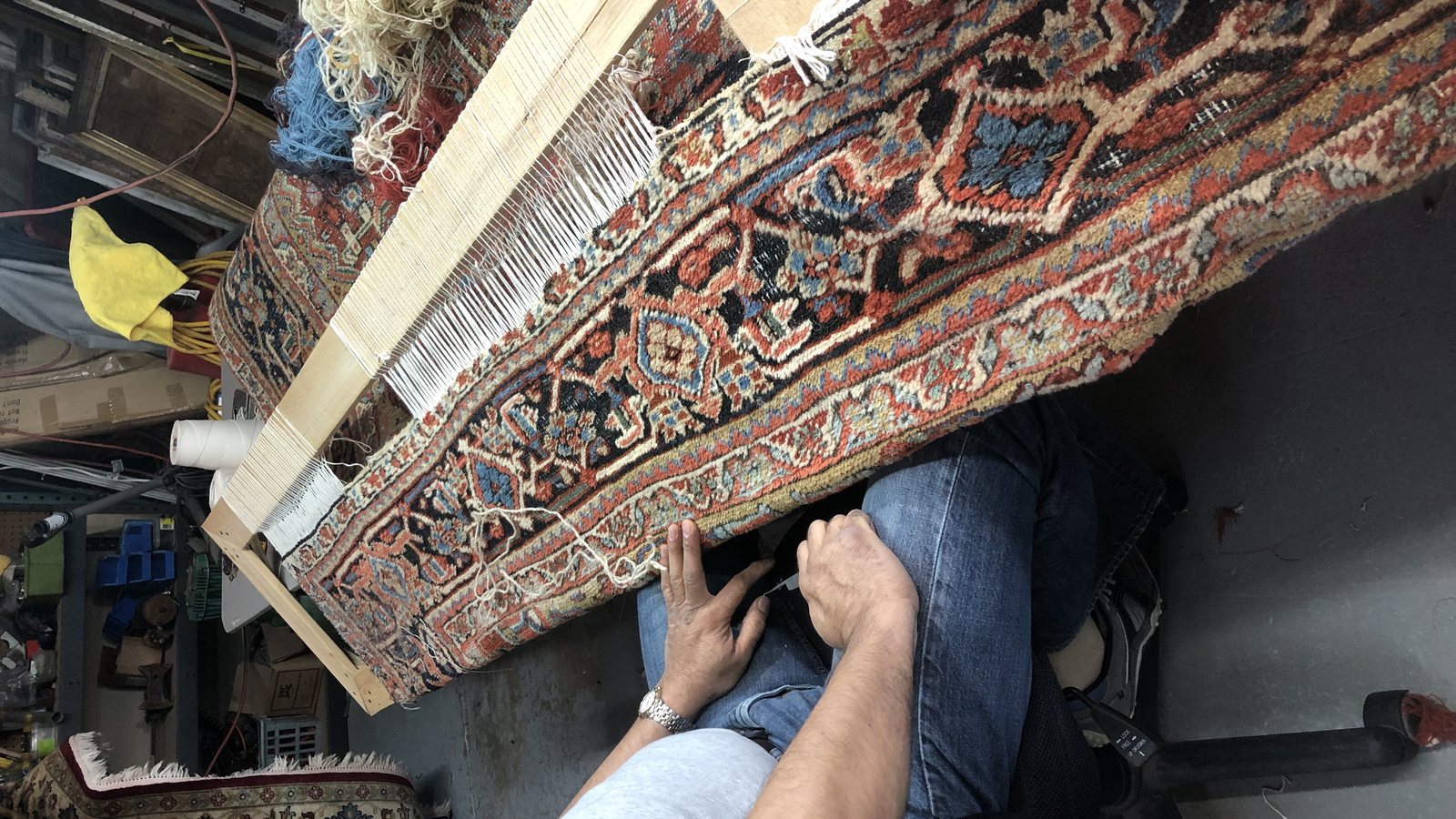
That is slow work. Reweaving is measured in square inches, not square feet, and a hand
on a loom is the only tool that does it properly. The upside is that damage most
people assume is terminal usually is not. Rugs arrive folded around a hole and go home
flat and whole.
Every repair starts with a free assessment and a straight verdict. If the cost of the
work is out of proportion to what the rug is worth, we say so instead of taking the
job.
Hand reweaving: matched wool knotted back into an oriental rug foundation.
What We Fix
Repair & Restoration Services
From a short fringe tidy to rebuilding a foot of missing border.
Fringe Repair & Replacement
Fringe is the end of the rug’s foundation, not decoration, so when it shreds the
rug is unravelling. The commonest cause we see is not age, it is a vacuum beater bar
taking a few warps a week for ten years. We secure the ends, rebuild lost warps, and
replace or re-knot fringe to match the original.
Edge Binding & Serging
Side cords take the abuse, and in a single house they take it in one place: a rug
under a swinging piazza door wears on a line rather than over an area, so the
selvedge fails long before the field looks tired. Once it splits, the pile beside it
starts letting go. Edges are rewrapped by hand in matched wool.
Reweaving & Hole Repair
Burns, tears and worn-through areas are rebuilt knot by knot. The foundation goes
back first, then the pile, matched in fibre, colour and density to the field around
it.
Old Repairs Made Good
Charleston houses are full of rugs mended decades ago with whatever wool was to
hand, in a room where nobody was going to look closely. Those patches age at their
own rate, so they step forward the moment the field around them is cleaned. They can
be taken out and rewoven properly — and it is worth knowing they are there
before the rug is washed rather than after.
Pet Damage
Chewed corners, clawed edges and urine-burnt dye. The rug is decontaminated first,
then the missing structure is rebuilt and colour corrected where the original dye
was destroyed.
Colour & Dye Correction
Bleach spots, dye that migrated during a bad cleaning or a soaking, and the pale
chalky band along the edge that lay against a masonry wall. Colour is rebuilt by
hand where the fibre underneath is still sound.
Resizing & Reshaping
Rugs cut down to fit a narrow downtown room, or blocked back to square after years
of buckling. Cut edges are properly finished so the rug reads as intentional rather
than amputated.
Backing & Foundation Repair
Failed latex on hand-tufted rugs, split warps in antiques, and rugs that ripple
because the foundation gave way. Cellulose foundations are also the part of a rug
that insects go for, so damage found on the back is assessed as a structural problem
first. Structure gets fixed before anything cosmetic.
Rug Pads & Prevention
A great many of the repairs we do could have been avoided by a decent pad and a
vacuum with the brush switched off. We fit breathable, non-adhesive pads sized to
the rug, which matters most in a doorway, where a rug that shifts under a swinging
door wears twice as fast.
Wet Rug Service
Leaks, Flood & Water Damage Rug Restoration
A supply line behind a washing machine, a water heater at the end of its life, rain
driven in along an open piazza, or a floor that was wet-mopped under the rug once a
week for a whole letting season. The rug on that floor is now on a clock.
Why speed matters more than anything else
Wool survives being wet surprisingly well. What it does not survive is staying wet.
In a warm room mould establishes in a saturated foundation in roughly forty-eight
hours, and once it is at the base of the pile you cannot vacuum, spray or air-dry it
back out. Meanwhile unstable dyes start migrating, cotton foundations begin to rot,
and whatever the water picked up on the way in is curing into the rug.
The slow version does the same damage without ever looking like an emergency. A rug
put back onto a floor that was mopped an hour ago is taking water from underneath,
and a rug that does that weekly never gets a genuinely dry stretch — the edges
nearest the doorways go soft first, and nobody connects it to anything. Either way, a
fan pointed at a wet rug is not restoration: it dries the surface, locks the
contamination into the foundation, and produces a rug that smells fine for three
weeks and then does not.
What to do before we arrive
Get the rug off the wet floor and out from under furniture — wooden legs bleed stain into a damp pile within hours.
Do not roll it tightly in plastic. That is an incubator. Loose and airy beats sealed.
Photograph it wet, in place, before moving anything. Your insurer will want that.
Do not half-rinse it with a hose and leave it. That sets the contamination and complicates the real wash.
If the house is a rental and you are elsewhere, send the housekeeper or the manager to lift it and photograph it. Days matter more than distance.
The restoration sequence
Priority collection. Wet rugs are run ahead of routine cleaning where the schedule allows.
Category assessment. Clean supply water, grey water and flood water are three different jobs, and which one you have decides the method.
Extraction and full flush. Contaminants and dissolved salts are washed out of the foundation, not sealed in behind a dry surface.
Antimicrobial treatment. Applied to the whole rug, front and back, before drying starts.
Monitored flat drying. Forced filtered air with moisture readings taken to completion, so nothing goes home damp.
Dye-bleed correction. Colours that migrated while the rug was wet are pulled back where the fibre allows.
Structural repair. Rotted foundation and lost pile rewoven once the rug is stable and dry.
Claim documentation. Photographs and a written condition report for your insurance carrier.
Send pictures of the damage, or we collect the rug at no charge anywhere on the Charleston and Berkeley route.
2
Assessment & Quote
The damage is mapped, materials identified, and you get a written price with options. No work starts without your approval.
3
Clean First
Repairs go onto a clean rug. Working new wool into a dirty field leaves a visible patch a year later.
4
Materials Matched
Wool selected by fibre, weight and dye lot against the original, and tested against the field before it goes in.
5
Hand Repair
Foundation rebuilt, then pile knotted in at matching density, then sheared to the surrounding height.
6
Final Check & Return
Groomed, inspected against the intake photographs, and delivered back to your floor.
Questions
Repair & Restoration FAQ
Is my rug worth repairing?
You get a straight answer before any work starts. Repair makes sense when the rug
has real value — sentimental or monetary — and the foundation is sound.
When the cost of the work approaches what the rug is worth, we say so rather than
quietly running up an invoice.
How long does rug repair take?
It depends entirely on the area involved, because reweaving is hand work measured in
square inches. You get a timeline with the written quote, before you commit. Water
damage is handled differently because it is time-critical, so those rugs go into the
process as soon as they arrive rather than waiting their turn.
My rug is only worn along one edge. Why?
Almost always a door. A rug that sits where a door swings across it takes its wear on
a line rather than over an area, which is the classic pattern in a single house where
the piazza door is the door everybody uses. The selvedge goes first, then the end
weft, and the rug starts letting go from the edge inward while the field is still
perfect. It is a repair rather than a cleaning problem, and a pad that stops the rug
shifting under the swing is most of the prevention.
Will the repair be visible?
A good reweave is difficult to find once the pile is groomed. Wool is matched by
fibre, dye lot and knot density, and the foundation is rebuilt before the pile so the
repaired area wears at the same rate as the rest of the rug rather than sinking or
standing proud over time.
The house is being treated for termites. What should I do with the rugs?
Get them out of the house rather than into a corner of it. When a building is treated
or tented everything comes off the floor at short notice and gets rolled and stacked
by people whose job is the building rather than its contents — which is how rugs
end up rolled dirty, rolled damp, folded instead of rolled, or stood on end on a
garage slab for a week. Ideally the rugs leave clean and come back afterwards. Worth
knowing too: the foundation of a rug is cellulose, so it is not automatically outside
what those insects will take, and the damage starts on the underside.
Do you work with insurance claims?
Yes. Condition is photographed at intake and throughout, and you get written
documentation of damage, treatment and value impact to submit to your carrier.
My rug ripples and will not lie flat. Can that be fixed?
Usually. Buckling comes from an uneven foundation, past improper drying, or years on
a pad that was too soft. The rug is washed, blocked back to square under tension, and
the foundation repaired where it has stretched or torn.
Send Us a Photo. We Will Tell You Straight.
Free assessment on every repair, and a real answer about whether it is worth doing.