Now booking: collection runs from South of Broad out to Kiawah — start an estimate
Serving the Lowcountry
Rug Cleaning

Professional Rug Cleaning in Charleston

Every rug is washed by hand, off site — not cleaned in place with a wand over your floorboards, and never run through a machine that treats silk like a doormat.

The Difference

Why Rug Cleaning Is Not Carpet Cleaning

Wall-to-wall carpet is stretched and tacked over a pad. It has a backing that seals it, it drains downward into that pad, and it tolerates a fairly aggressive approach. An area rug is the opposite: open on both faces, sitting directly on your floor, often held together by hand-tied knots on a cotton warp that is more than a century old.

When someone cleans a rug in place with a hot-water wand, three things happen. Soil at the base of the pile gets pushed deeper rather than lifted out. Water goes into the foundation with nowhere to go. And in an old Charleston house the floor underneath is rarely a neutral party — original boards, a masonry-walled room, and building fines already down in the pile all mean that wetting a rug where it lies makes a chemistry problem out of a soiling one.

Off-site washing exists to avoid all of that. The rug leaves the house, gets its dry grit removed before any water is introduced, is washed and rinsed until the water runs clear, and is dried flat in moving air. Then it comes back.

Learn how rugs are constructed

A wool rug hanging on the rack with rinse water running clear off the pile
Wool rug being rinsed, clean water sheeting off the pile.
Step by Step

The Cleaning Process

Six stages, in this order, every time. Skipping any of them is how rugs get damaged.

Inspection & Dye Testing

The rug is opened flat and examined front and back. We identify fibre and construction, log existing damage and old repairs, and test each colour for bleeding and for crocking — dye that rubs off dry, which older indigo will do. Findings drive the wash plan, and you are told about anything we find.

Dry Grit & Dust Removal

Before water, the dry material comes out. A rug from a peninsula house holds street grit off cobbled and paved surfaces and building fines off plaster and mortar, all of it down at the foundation. Compressed-air dusting and controlled beating shake it loose — the single most important step for how long a rug lasts.

Pre-Treatment

Spots, pet accidents, oily residue and traffic lanes are treated individually with chemistry matched to the fibre, then given dwell time. Wool and silk get a neutral pH; lipids get a solvent-side treatment before any water; synthetics can take something stronger.

Full Immersion Wash

The rug is submerged and washed by hand with soft brushes worked in the direction of the pile, so suspended soil floats free instead of being ground in. Immersion is also what carries alkaline building salts out of a foundation, which no surface method does. Delicate and unstable-dye rugs get a low-moisture method instead.

Rinse & Controlled Drying

Flushing continues until the water runs clear, because leftover detergent is a magnet for new soil. Water is then pulled out mechanically and the rug dries flat under moving filtered air — not in the sun, which fades dye and hardens wool.

Grooming & Final Check

Pile is groomed back into direction, fringe is cleaned and straightened, and the rug is inspected against the intake notes. Anything unresolved is flagged before it is wrapped for delivery.

Recent work

Before and After

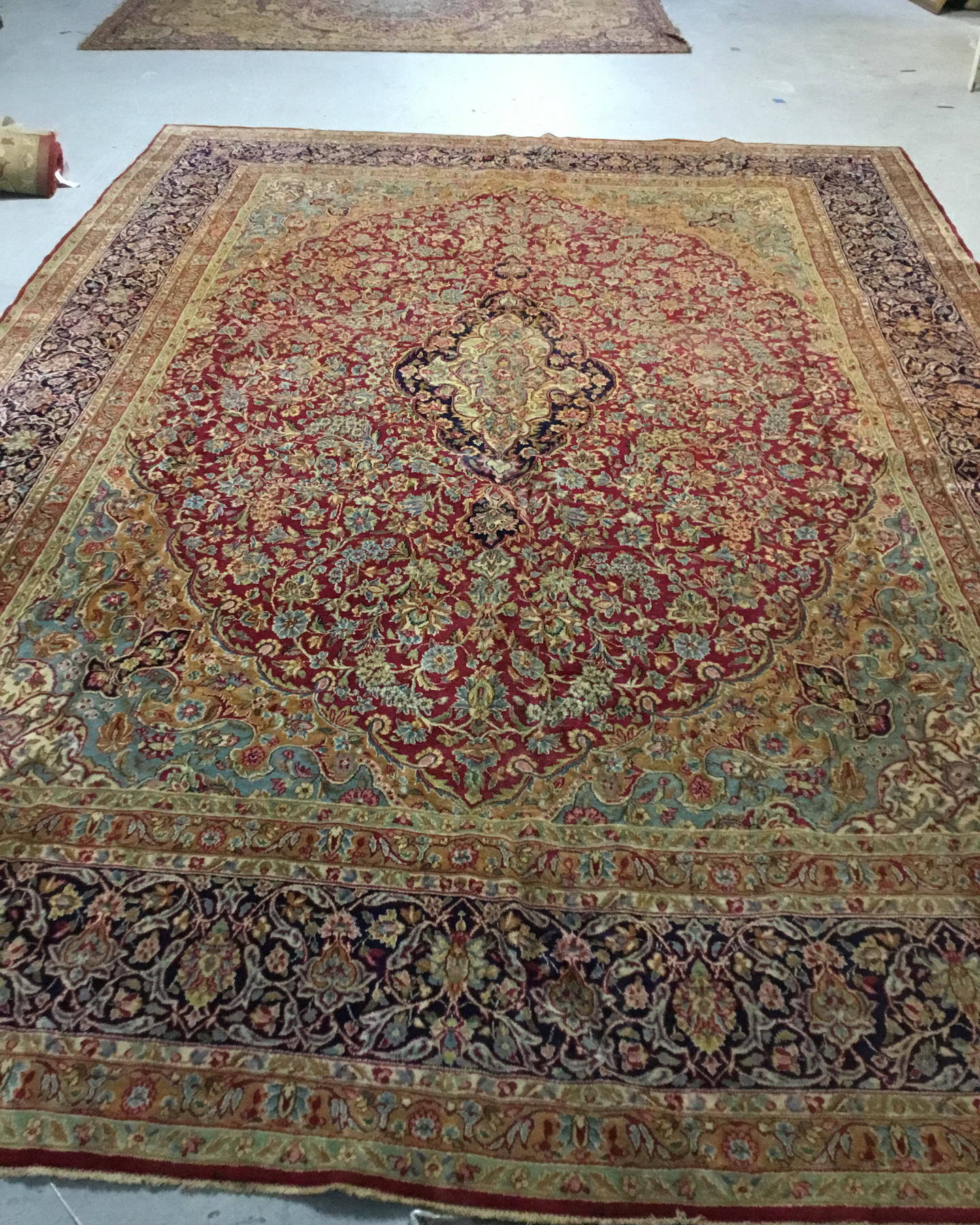
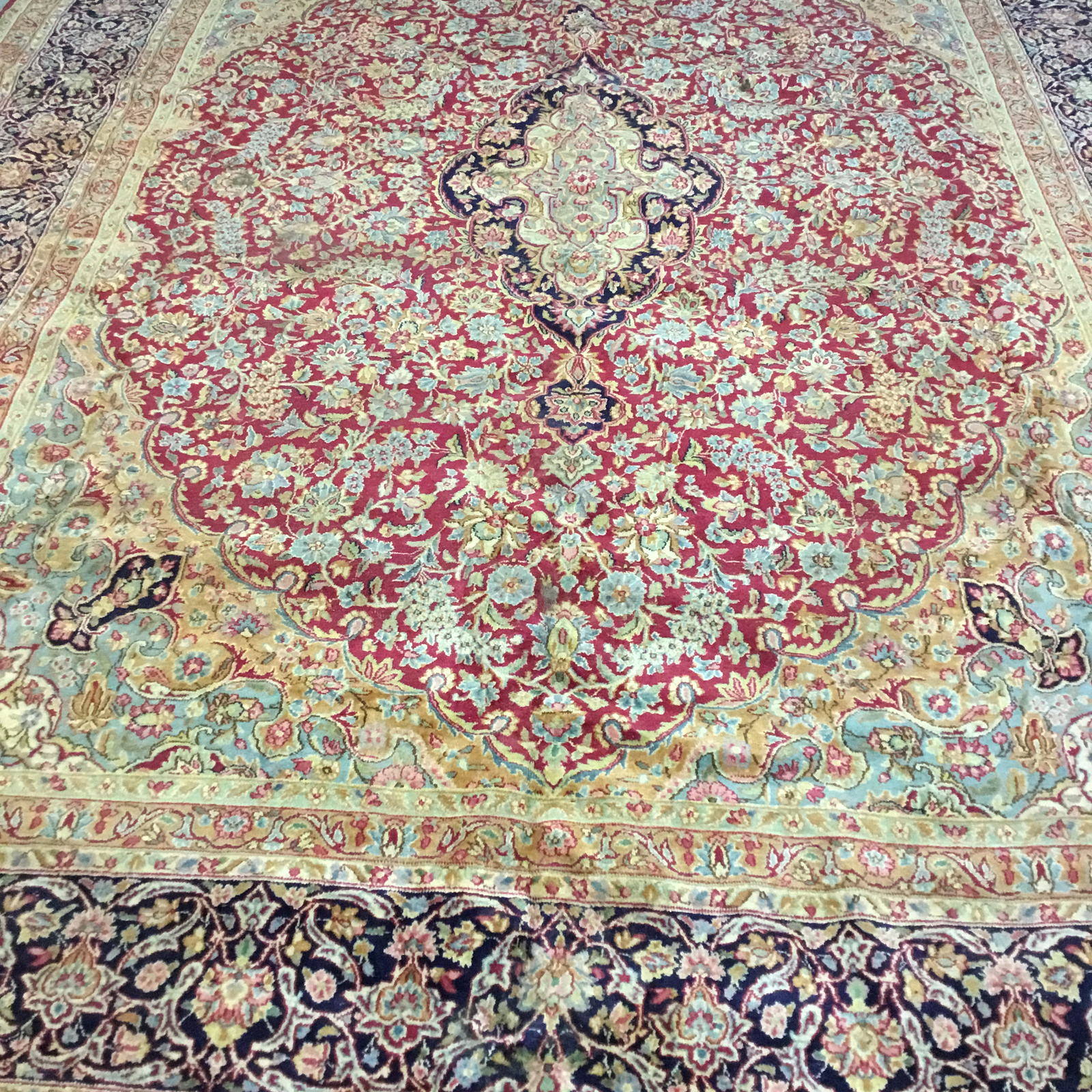
One hand-knotted Persian rug, photographed before and after cleaning.

Before
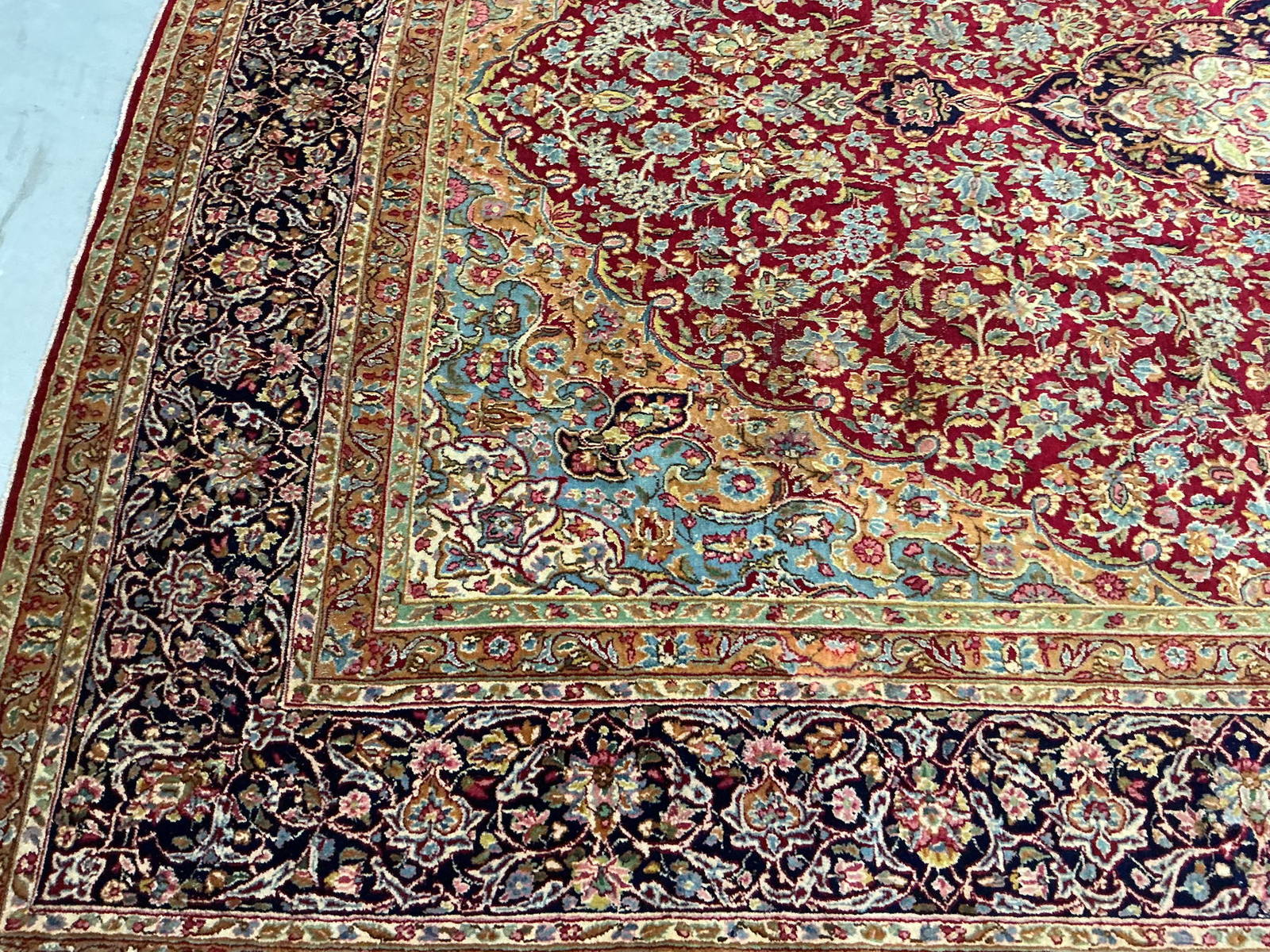
Hand-knotted Persian rug before cleaning, the deep red field and blue-green floral tracery muted and greyed
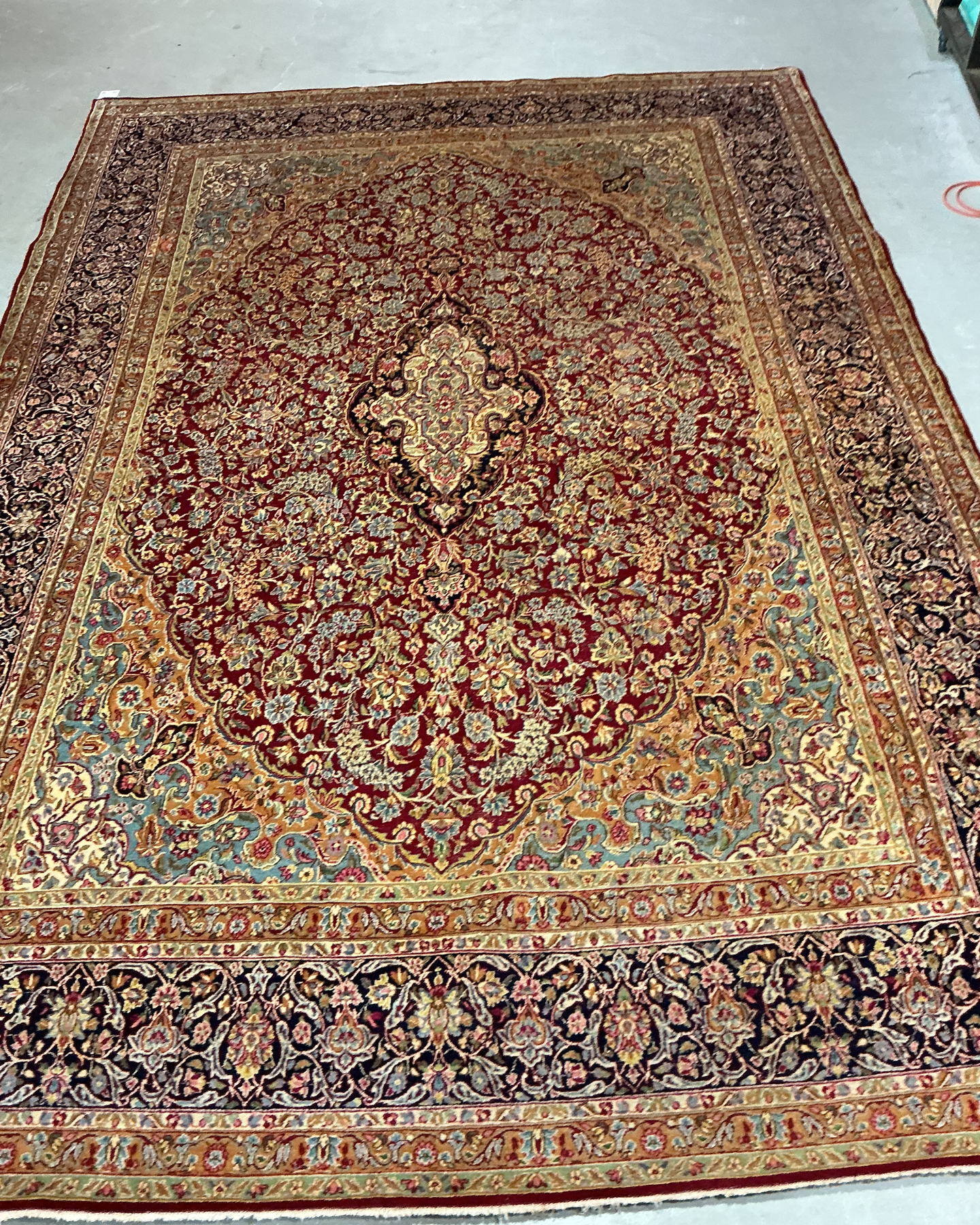
After
The same rug after cleaning, with the red field, gold corner spandrels and blue-green florals showing clearly
A hand-knotted Persian, before and after cleaning.
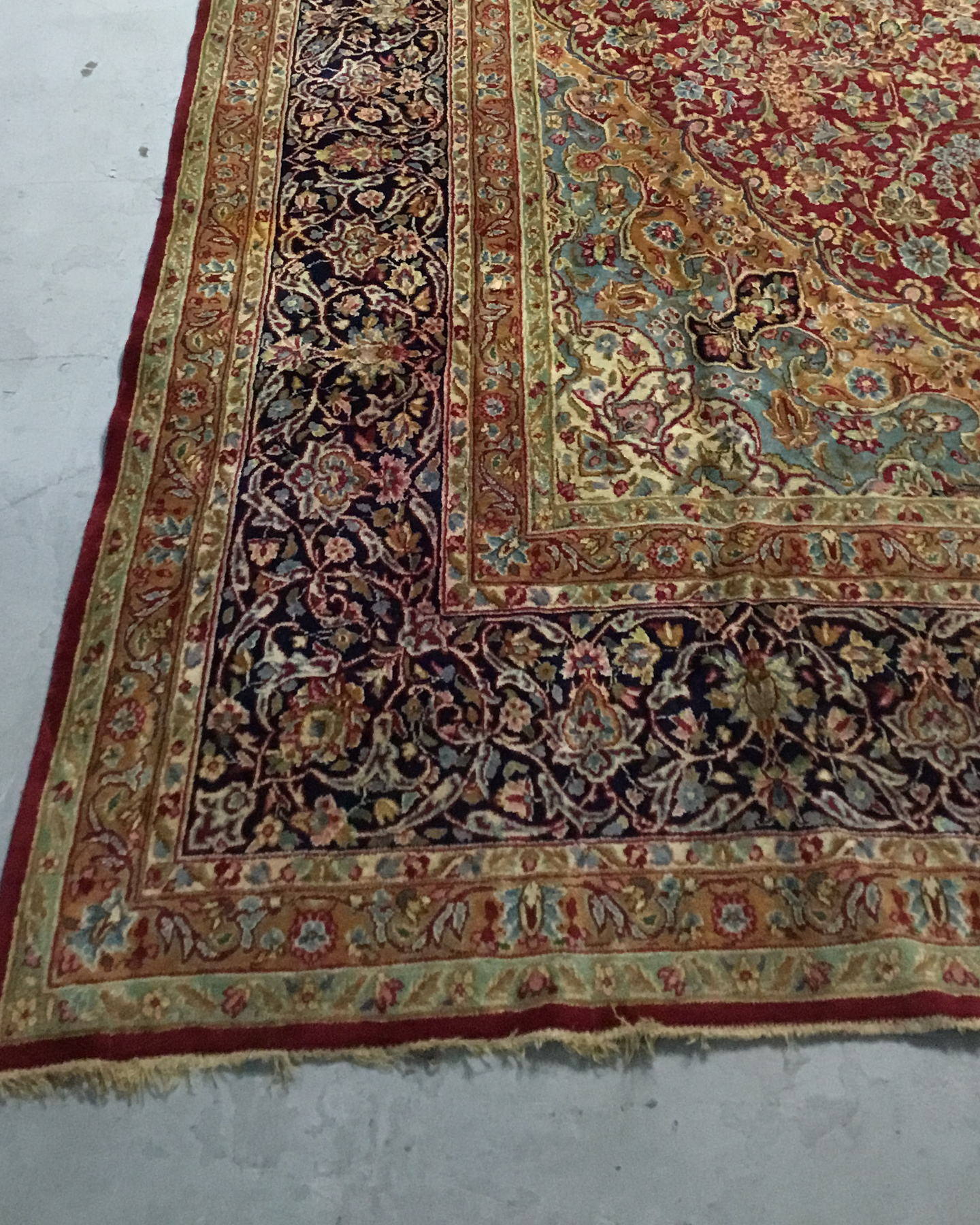
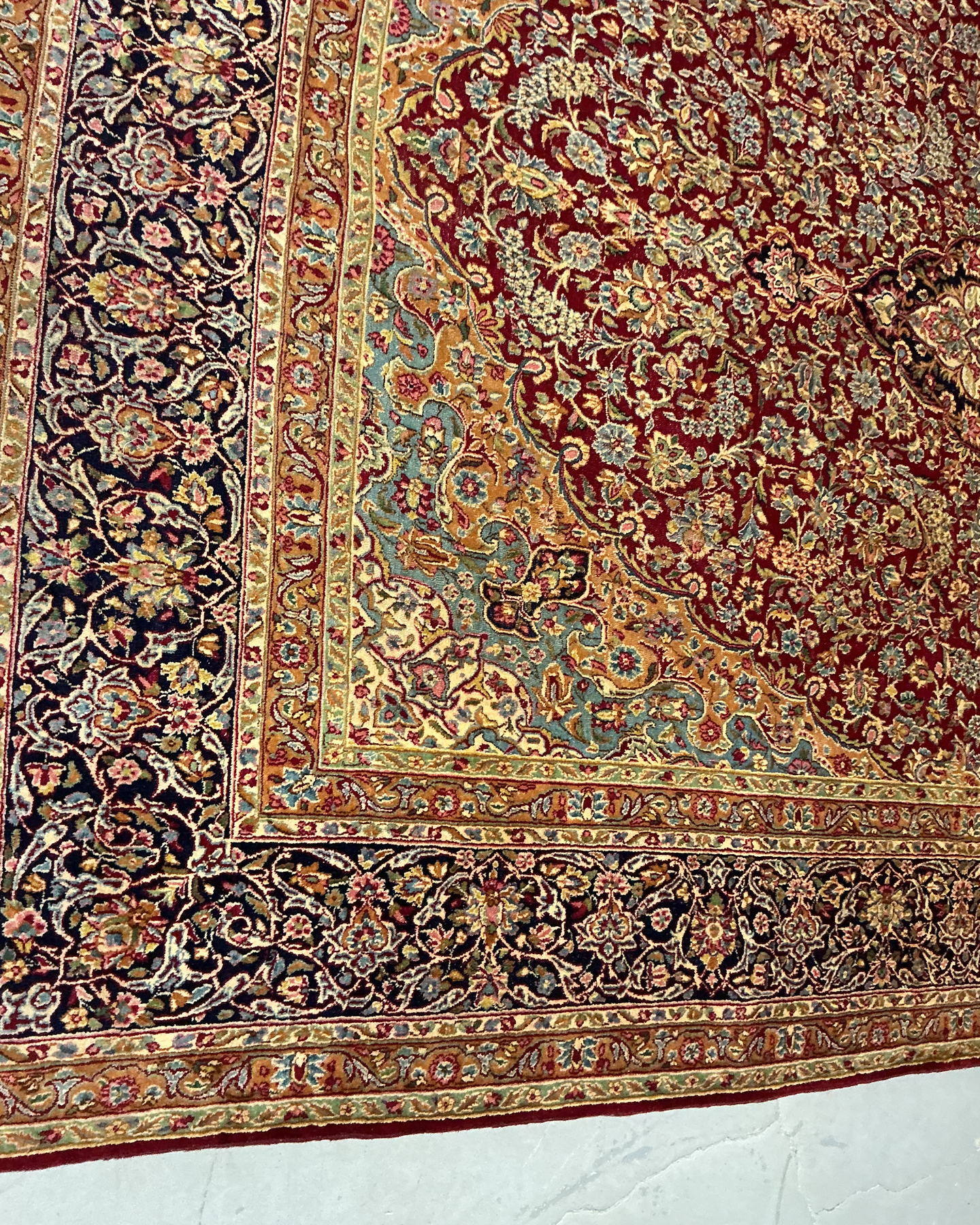
Before
Corner of the same rug before cleaning, the navy border and ivory fringe dulled and flattened in tone
After
The same corner after cleaning, with the navy border, gold guard bands and ivory fringe distinct again
Corner detail — border, guard stripes and fringe.
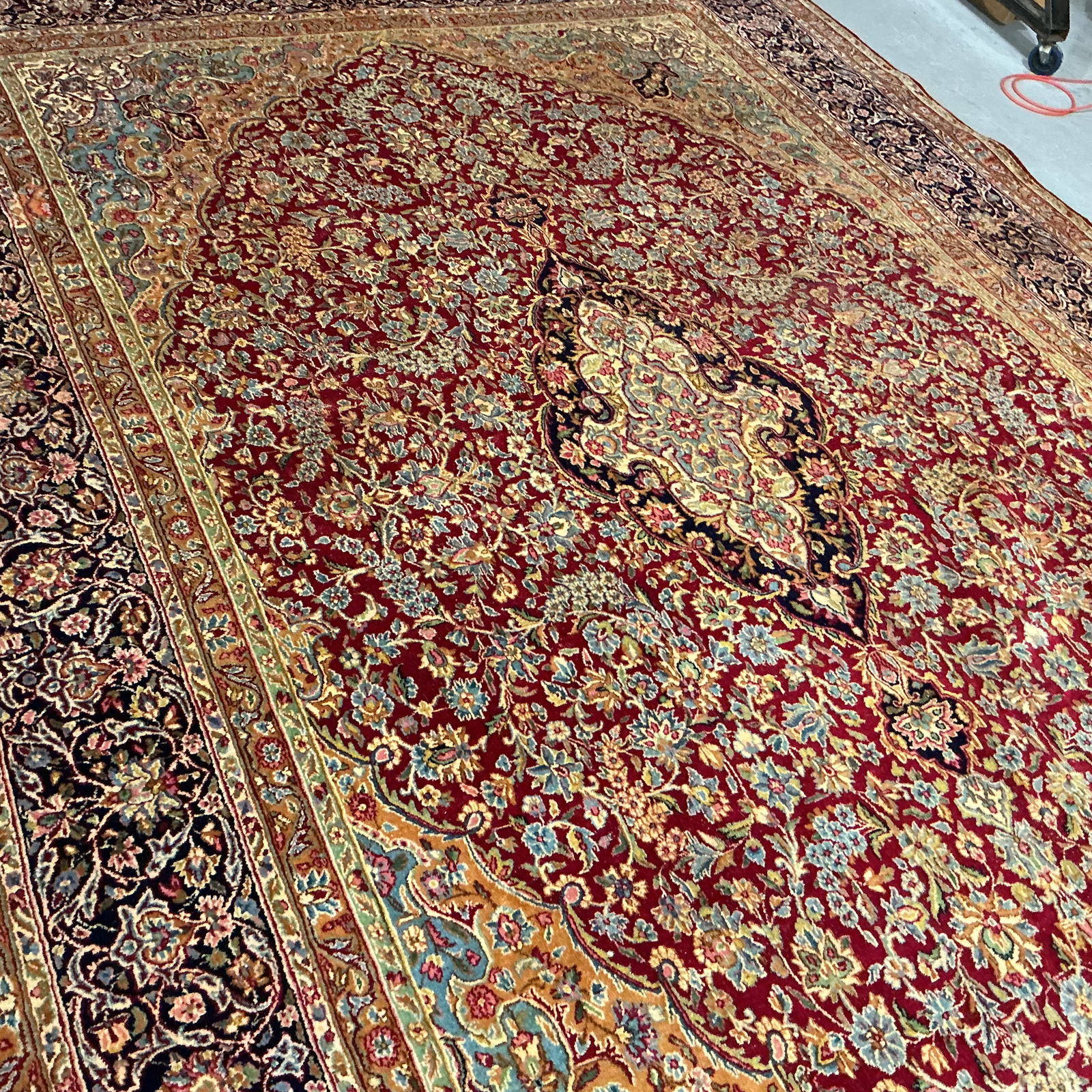
Before
Centre of the same rug before cleaning, the navy medallion and red field hazy and low in contrast
After
The same medallion after cleaning, the cream and gold palmette reading crisply against the navy and red
The central medallion and the field around it.
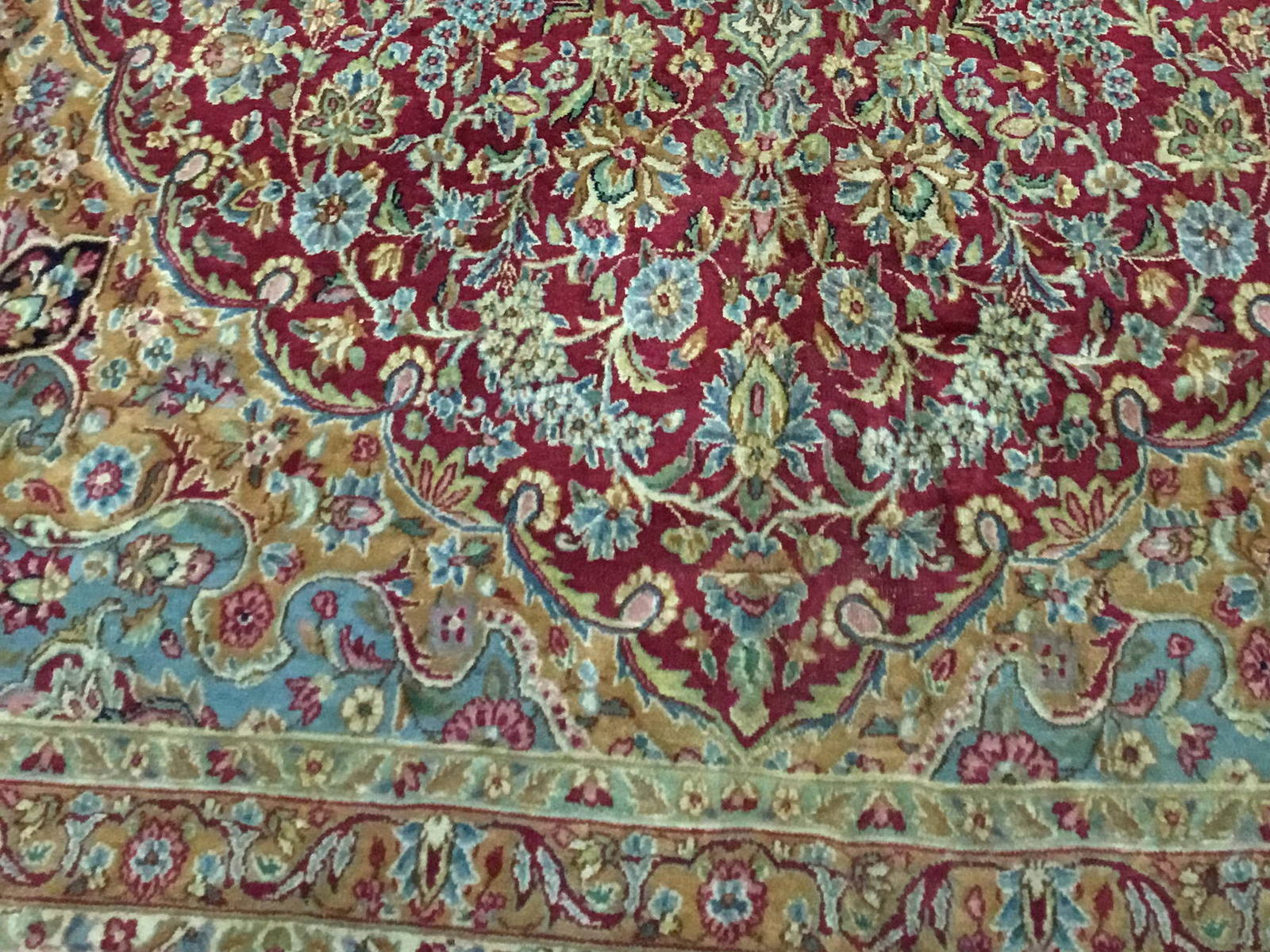
Before
Field meeting border on the same rug before cleaning, the blues and pinks greyed and indistinct
After
The same section after cleaning, with the pale blue scrollwork and pink florals separated and legible
Where the field meets the border.
What We Accept

Rug Types We Clean

If it lies on a floor, it has an appropriate method. Each type gets its own handling.

Fibre and construction types, with the handling each one needs.
Rug type How we handle it
Hand-knotted Persian & oriental Full immersion wash, dye-tested first. Fringe cleaned by hand. Antique pieces get reduced agitation and extra drying time.
Wool area rugs Neutral-pH immersion wash. Lanolin is preserved rather than stripped, which is what keeps wool resisting soil.
Silk & art silk (viscose) Low-moisture specialist cleaning. Viscose in particular yellows and stiffens if it is over-wet, so it never goes into immersion.
Cotton flatweaves & dhurries Washed with tight moisture control and dried under tension so the reversible weave does not pucker or shrink.
Jute, sisal & seagrass Dry or very-low-moisture methods only. These plant fibres brown from their own water, so the risk is the cleaning as much as the spill.
Hand-tufted rugs Washed carefully around the latex adhesive layer, which is the part that fails with age and produces that unmistakable old-glue smell.
Machine-made synthetics Polypropylene, nylon and polyester take a thorough wash and a stronger pre-treatment. Very good results for the money.
Shag, hides & sheepskin Specialty handling with fibre-specific cleaning agents and hand finishing to bring the loft back.
Local Specialties

Problems Charleston Rugs Actually Have

Street Grit & Building Dust

Two different hard particles arrive in a peninsula rug and they need the same answer for different reasons. Cobble and Belgian-block streets grind a sharp mineral grit out of the joints between stones, and it comes in on shoes across a piazza that is swept rather than cleaned. Renovation adds lime plaster and mortar fines, which are alkaline — and wool wants a mildly acidic environment, so they are working on the fibre rather than merely sitting on it. Both have to come out dry, before water. Wetting plaster fines in place turns them into a slurry that sets in the base of the pile, and wetting grit just packs it tighter against the knots.

Jute, Sisal & Viscose

Coastal decorating puts an enormous amount of plant fibre on Lowcountry floors, and plant fibre is cellulose. Cellulose browns from its own water: lignin travels with the moisture to wherever the fibre dries last and leaves a halo darker than the spill that caused it. Viscose — sold as art silk, bamboo silk or banana silk — is the same chemistry with worse manners, losing most of its strength when wet and yellowing from clean water alone. Neither goes into immersion. Both get low-moisture handling and an honest word about what will not come out.

Pet Urine & Stains

Urine soaks straight through the pile and sits in the foundation, where it burns dye if it is left and where nothing sprayed on the surface reaches it. In a house that is walked in and out of all day — which describes most of Mount Pleasant and all of I’On — it is also usually found late, because the smell is competing with an open door. The contamination is flushed out entirely, and discolouration is corrected where the dye underneath survived.

How the Work Is Set Up

Washed Off Site, Flat

Rugs are collected and washed away from the house, then dried flat in moving air rather than hung wet or dried on your floor.

Safe for Every Fibre

Dye testing and fibre identification happen before water. Neutral chemistry on wool and silk, stronger treatment only where it is safe.

Collection & Delivery

Charleston and Berkeley counties, both directions, included. Furniture gets moved off the rug too.

Plain Answers

You get told what we find at intake, what it will cost, and what will not come out. Nothing starts before you agree to it.

Questions

Frequently Asked Questions

How long will my rug be away?
You get a timeline with the quote, before anything starts. Drying is the slow part, because a rug is dried until it is actually dry rather than until the schedule says so. Heavy pet contamination, dye bleeding or repair work extends it, and we tell you that up front rather than afterwards.
Can you collect from a rental property between guests?
Yes, and downtown and on the islands it is a common arrangement. Rugs are regularly collected through a property manager, a housekeeping company or a lockbox, and returned to fit a booking calendar rather than an owner’s diary. Tell us in the form who holds access and what the changeover day is, and we will work to it. Condition is photographed at collection, so there is a record of what the rug looked like before it left.
Do you clean every kind of rug?
Hand-knotted Persian and oriental rugs, wool, silk, cotton flatweaves, jute and sisal, viscose, hand-tufted rugs, machine-made synthetics, hides and shag. Each fibre gets a different wash, and several — antique silk and viscose especially — are handled by low-moisture methods only.
Is collection and delivery really included?
Yes, throughout Charleston County and Berkeley County. We collect the rug, move the furniture off it, and bring it back rolled and ready to lay down. There is no charge in either direction. On the peninsula that includes getting it down a piazza and out through a garden gate, which is usually the awkward part.
Will washing shrink my rug or make the colours run?
Not when the wash is matched to the rug. Every colour is tested before water touches the pile — for bleeding and for crocking, since older indigo will rub off dry without ever running wet — and if a dye is unstable the method changes to low-moisture or gains a dye-setting step. Shrinkage comes from over-wetting a cotton foundation and drying it under tension, which is exactly what controlled flat drying avoids.
How often should a rug be cleaned here?
As general guidance, every twelve to eighteen months for a rug in a main living area. The local reasons to be at the shorter end of that are specific: an entry sequence that crosses a piazza, building work in the neighborhood, a ground-floor room open to the public, or a house that is let by the week. Guest rooms and low-traffic rugs can stretch to two or three years. Any rug that has been wet should be dealt with immediately rather than eventually.
The border of my rug has gone chalky and pale. What is that?
Usually the wall rather than the rug. Solid brick and lime mortar carry soluble mineral salts to the surface as they take up and give back moisture, and they crystallise low down where the wall meets the floor. A rug edge lying along that skirting takes them into its foundation, and they are alkaline enough to shift the pH the wool is sitting in and to unsettle dye in a band. It is a rinse-and-neutralise job worked from the back, and it is much easier to deal with as a band than as a hole.
What does rug cleaning cost?
Pricing is by square foot and depends on fibre, construction and condition — a machine-made synthetic and a hand-knotted silk are not the same job. You get a quote before any work begins, the estimate is free, and there are no additions when the rug comes back. Send us the details and we will come back with a number.

Get In Touch

Book a Collection

Tell us roughly what you have and where you are, and we will get it on the route.

  • Service area
    Charleston County and Berkeley County, South Carolina
    Collection & delivery included throughout
  • Hours
    Mon–Sat: 9:00 AM – 5:00 PM
    Sunday: Closed

Free Cleaning Estimate

Ready for a Cleaner Rug?

Free estimate, collection included, and a rug that comes back the way you remember it.

Rug Repair & Restoration

Fringe, selvedge, grazed pile and reweaving — what can be fixed and what it involves.

Repair services

Water Damage Recovery

What to do in the first forty-eight hours after a rug takes a leak, a storm or a flooded floor.

Water damage

The Rug Owner’s Guide

Knots, fibres, construction, and how to care for all of it in a Charleston house.

Read the guide
Start a Free Estimate Service Areas